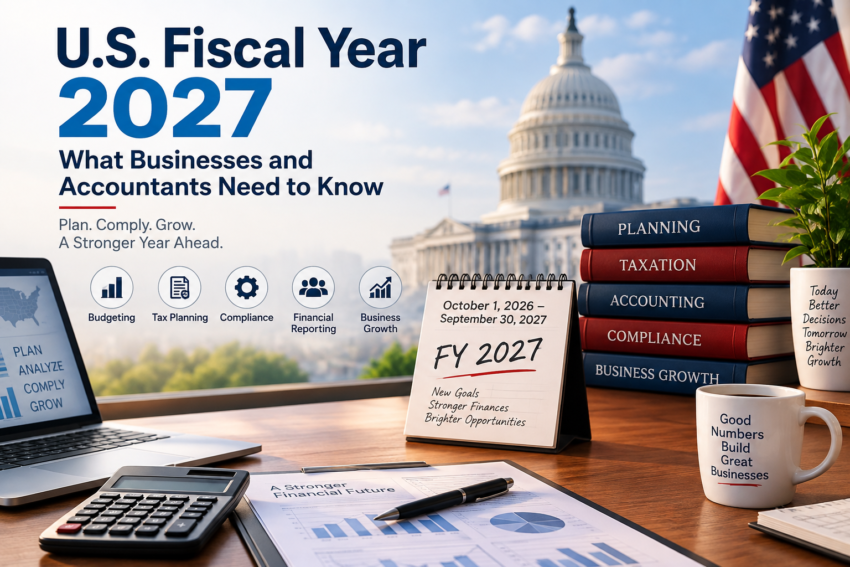
The U.S. Fiscal Year 2027 (FY 2027) begins on October 1, 2026, and ends on September 30, 2027. The start of a new fiscal year is an important planning period for businesses, accountants, and finance teams.
FY 2027 is an opportunity for businesses to review their budget, cash flow, tax planning, financial reporting, payroll, and compliance processes. However, businesses should understand that the federal fiscal year is not necessarily the same as their tax year.
What Is the U.S. Fiscal Year 2027?
The U.S. federal government follows a fiscal year from October 1 through September 30 of the following year.
For example:
- FY 2026: October 1, 2025 – September 30, 2026
- FY 2027: October 1, 2026 – September 30, 2027
- FY 2028: October 1, 2027 – September 30, 2028
The federal fiscal year is primarily used for government budgeting, spending, and financial reporting.
Businesses may follow a calendar year or another permitted fiscal year. Therefore, FY 2027 does not automatically mean Tax Year 2027 for every business.
Why Does FY 2027 Matter to Businesses?
The beginning of a new financial cycle gives businesses an opportunity to evaluate their financial performance and prepare for upcoming obligations.
Businesses should review:
- Revenue and expense forecasts
- Cash-flow requirements
- Working capital
- Payroll expenses
- Capital expenditures
- Debt obligations
- Tax positions
- Financial reporting
- Internal controls
Early planning can help businesses identify financial and compliance issues before they become significant problems.
1. Review Your Business Budget
A new fiscal cycle is a good time to compare previous budgets with actual results.
Businesses should analyze revenue, operating expenses, payroll, marketing costs, technology expenses, rent, insurance, and other major costs.
Budgeting should also consider the timing of cash inflows and outflows. A business can generate strong revenue while still experiencing cash-flow pressure if customers take longer to pay.
2. Focus on U.S. Tax Planning
U.S. tax planning should be based on the company’s actual tax year and applicable federal, state, and local requirements.
Businesses should review potential deductions, credits, depreciation, interest expense limitations, and information-reporting requirements.
Recent federal tax changes have affected several business tax provisions. Companies should monitor IRS guidance and determine which changes apply to their specific circumstances.
Maintaining accurate tax records throughout the year can make tax preparation more efficient and reduce last-minute adjustments.
3. Review Depreciation and Capital Expenditures
Businesses purchasing equipment, machinery, vehicles, or technology should review the applicable depreciation rules.
Accountants should determine:
- Whether the purchase should be capitalized
- When the asset was placed in service
- The appropriate depreciation method
- Whether accelerated depreciation applies
- Whether book and tax depreciation differ
Book depreciation and tax depreciation may produce different results, so businesses should maintain appropriate records for both financial reporting and tax purposes.
4. Understand Book-to-Tax Differences
One of the key areas of U.S. accounting and taxation is understanding the difference between book income and taxable income.
Differences can arise from depreciation, accrued expenses, interest expense, certain penalties, meals and entertainment, and other tax adjustments.
The basic process can be viewed as:
Book Income → Tax Adjustments → Taxable Income
Maintaining supporting schedules throughout the year helps accountants prepare accurate tax returns and explain differences between financial statements and tax returns.
5. Monitor Cash Flow
Profit and cash are not the same.
A business may report revenue from credit sales even though the customer has not yet paid. This is why businesses should monitor accounts receivable, accounts payable, inventory, payroll obligations, taxes, loan payments, and capital expenditures.
Regular cash-flow forecasting can help businesses identify potential funding requirements and manage working capital more effectively.
6. Strengthen Financial Reporting
Businesses should regularly reconcile important accounts, including:
- Bank accounts
- Credit cards
- Accounts receivable
- Accounts payable
- Payroll liabilities
- Loans
- Fixed assets
The Profit and Loss Statement, Balance Sheet, and Cash Flow Statement should provide reliable information about the company’s financial position.
Unexplained or old balances should be investigated rather than continuously carried forward.
7. Review Payroll and Vendor Compliance
Payroll and vendor records are important areas of U.S. tax compliance.
Businesses should maintain accurate payroll records and regularly reconcile payroll liabilities.
For vendors and independent contractors, businesses should maintain appropriate W-9 information, payment records, taxpayer identification details, and information needed for applicable 1099 reporting.
Good recordkeeping throughout the year can reduce compliance issues during tax season.
Fiscal Year vs. Tax Year
Businesses should not assume that the federal fiscal year and their tax year are identical.
The federal government uses October 1 through September 30 as its fiscal year. A business may use a different tax year depending on its circumstances and applicable tax rules.
Before making tax decisions, businesses should confirm:
- Their accounting period
- Their tax year
- Applicable federal tax rules
- State and local requirements
- Upcoming filing deadlines and elections
Final Thoughts
The U.S. Fiscal Year 2027 begins on October 1, 2026, and ends on September 30, 2027. For businesses and accountants, it is a useful opportunity to review budgeting, tax planning, cash flow, financial reporting, payroll, and compliance processes.
Businesses that maintain accurate books, reconcile accounts regularly, monitor tax developments, and plan ahead can enter the new fiscal cycle with better financial visibility and stronger accounting processes.
Disclaimer: This article is for general informational purposes only and should not be considered tax, accounting, or legal advice. Businesses should consult a qualified professional regarding their specific circumstances.