Introduction
Understanding taxes can be challenging, especially when you come across terms like tax credits and tax deductions. Although both can help lower your tax bill, they work in different ways.
Knowing the difference between tax credits vs. tax deductions can help you understand your tax return and make better financial decisions. In addition, learning how these tax benefits work can help you identify deductions and credits you may qualify for.
In this blog, we will explain tax credits and tax deductions, compare their key differences, and share examples to help you understand how each one works under US federal tax rules.
1. What Is a Tax Deduction?
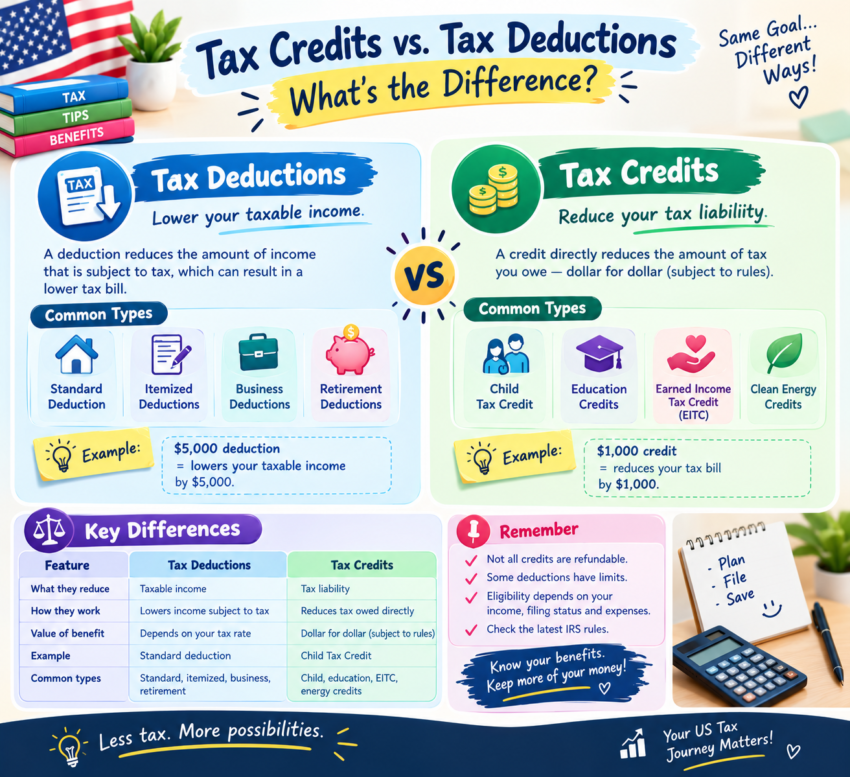
A tax deduction reduces the amount of income that is subject to tax. In other words, it lowers your taxable income rather than directly reducing the tax you owe.
For example, suppose your annual income is $60,000 and you qualify for a $5,000 tax deduction. Your taxable income may decrease to $55,000 before other applicable adjustments and deductions.
As a result, you may owe less federal income tax. However, the actual savings depend on your tax rate and the deductions you can claim.
Common Types of Tax Deductions
US taxpayers may qualify for different types of deductions, depending on their circumstances.
- Standard deduction: A fixed deduction amount that eligible taxpayers can generally claim instead of itemizing deductions.
- Itemized deductions: Eligible expenses reported on Schedule A, such as certain medical expenses, state and local taxes, mortgage interest, and charitable contributions, subject to applicable rules and limits.
- Business deductions: Eligible business expenses that may reduce taxable business income.
- Retirement-related deductions: Certain qualifying retirement contributions may be deductible, depending on the account type and applicable rules.
However, not every expense qualifies for a deduction. Taxpayers should review the IRS rules before claiming an expense on their tax return.
2. What Is a Tax Credit?
A tax credit directly reduces the amount of tax you owe. Unlike a deduction, which lowers taxable income, a credit reduces your tax liability dollar for dollar, subject to the rules for that credit.
For example, suppose your federal income tax liability is $4,000 and you qualify for a $1,000 nonrefundable tax credit. Your tax liability may decrease to $3,000.
Therefore, a tax credit can provide a direct reduction in the amount of tax you owe.
Common Types of Tax Credits
Depending on eligibility and current tax law, taxpayers may qualify for several federal tax credits.
- Child Tax Credit: May help eligible taxpayers with qualifying children.
- Earned Income Tax Credit (EITC): May benefit eligible workers and families with qualifying earned income.
- Education tax credits: The American Opportunity Tax Credit and Lifetime Learning Credit may help eligible students or taxpayers with qualifying education expenses.
- Child and Dependent Care Credit: May help eligible taxpayers with qualifying care expenses that allow them to work or look for work.
- Clean energy and energy-efficiency credits: Certain qualifying expenses may qualify for credits when permitted under the applicable tax rules.
Eligibility requirements, credit amounts, income limits, and other restrictions vary. Consequently, taxpayers should check the rules for the specific credit before claiming it.
3. Tax Credits vs. Tax Deductions: Key Differences
The main difference between tax credits and tax deductions is how they affect your tax bill.
| Feature | Tax deductions | Tax credits |
|---|---|---|
| What they reduce | Taxable income | Tax liability |
| How they work | Lower the income subject to tax | Reduce the tax owed directly |
| Value of the benefit | Depends on your applicable tax rate | Generally reduces tax dollar for dollar |
| Example | A $1,000 deduction reduces taxable income by $1,000 | A $1,000 credit reduces tax liability by up to $1,000, subject to its rules |
| Common examples | Standard deduction and eligible itemized deductions | Child Tax Credit and eligible education credits |
For example, a $1,000 deduction does not usually save you $1,000 in taxes. Instead, it reduces your taxable income by that amount.
By contrast, a $1,000 tax credit can reduce your tax liability by $1,000 if you can use the full credit. This is why understanding the difference between these two tax benefits is important when preparing a return.
4. Tax Credits vs. Tax Deductions: An Example
Let’s look at a simple example to understand how each benefit works.
Suppose a taxpayer has $60,000 in taxable income before considering a potential $1,000 deduction. For illustration, assume the taxpayer’s marginal federal income tax rate is 22% and that the deduction reduces income taxed at that rate.
If the taxpayer claims a $1,000 deduction:
- Taxable income decreases by $1,000.
- Estimated federal income tax savings are $220, based on the assumed 22% rate.
If the taxpayer qualifies for a $1,000 tax credit:
- Tax liability decreases by up to $1,000 if the credit is fully usable.
- The taxpayer may save more than they would from the deduction in this example.
Therefore, a $1,000 tax credit can provide a larger tax benefit than a $1,000 deduction. Actual results depend on the taxpayer’s full tax situation and the rules that apply to the particular benefit.
5. What Is the Difference Between Refundable and Nonrefundable Tax Credits?
Tax credits generally fall into two important categories: refundable and nonrefundable credits. Understanding this difference can help you determine how a credit affects your final tax result.
Refundable Tax Credits
A refundable tax credit can reduce your tax liability to zero. If the allowed refundable amount exceeds your tax liability, you may receive the remaining amount as a refund, subject to the credit’s rules.
For example, if your tax liability is $500 and you qualify for a $1,000 fully refundable credit, the credit may cover the $500 tax liability, with the remaining $500 potentially refunded.
Nonrefundable Tax Credits
A nonrefundable tax credit generally reduces your tax liability to zero but does not, by itself, provide a refund of any unused amount.
For instance, if your tax liability is $500 and you qualify for a $1,000 nonrefundable credit, you may use $500 of the credit. The remaining amount generally cannot be refunded, although some credits have special carryforward rules.
However, the treatment of each credit varies. Always check the relevant IRS instructions to understand how a particular credit works.
6. Standard Deduction vs. Tax Credits
The standard deduction and tax credits both help eligible taxpayers reduce their federal tax burden. Nevertheless, they work differently.
The standard deduction reduces taxable income by a set amount based on factors such as filing status and, where applicable, age or blindness. Tax credits, on the other hand, reduce tax liability directly.
For example, an eligible taxpayer may claim the standard deduction and also qualify for certain tax credits. The deduction helps lower taxable income, while the credits may reduce the resulting tax liability.
Taxpayers generally choose between the standard deduction and itemized deductions for the same federal return, subject to applicable rules. However, claiming the standard deduction does not automatically prevent them from claiming eligible tax credits.
As a result, understanding both benefits can help taxpayers prepare a more accurate return.
7. How Can You Qualify for Tax Credits and Deductions?
Eligibility depends on your income, filing status, family circumstances, expenses, and other factors. Therefore, you should review the requirements for each deduction or credit before claiming it.
Here are some practical steps to follow:
- Keep accurate records: Save income statements, receipts, and other supporting documents.
- Review your filing status: Your filing status may affect eligibility for certain tax benefits.
- Check income limits: Some credits and deductions have income restrictions.
- Understand qualifying expenses: Not every personal or business expense is eligible.
- Review IRS guidance: Use current IRS publications, forms, and instructions.
- Consider professional help: A qualified tax professional can help you understand complex rules and identify benefits you may qualify for.
In addition, keep records of any credits or deductions claimed on previous returns when they affect carryforwards or other tax calculations.
8. Common Mistakes to Avoid
Taxpayers sometimes miss valuable tax benefits because they misunderstand the rules. Fortunately, careful preparation can help prevent common errors.
Watch out for these mistakes:
- Confusing a tax deduction with a tax credit.
- Claiming expenses that do not qualify.
- Overlooking income limits or eligibility rules.
- Assuming every tax credit is refundable.
- Using outdated tax forms or credit amounts.
- Claiming the same expense more than once when the rules do not allow it.
- Failing to keep documents that support a claim.
Before filing your return, review each deduction and credit carefully. This extra step can help reduce errors and avoid possible delays or adjustments by the IRS.
9. Why Is This Topic Important for Aspiring Enrolled Agents?
For aspiring Enrolled Agents (EAs), understanding tax credits vs. tax deductions is an important part of learning US taxation.
Enrolled Agents are federally authorized tax professionals who can represent taxpayers before the IRS. Their work may involve reviewing financial records, preparing tax returns, explaining tax benefits, and helping clients understand their tax responsibilities.
A strong understanding of credits and deductions helps future EAs:
- Identify tax benefits that may apply to a client’s situation.
- Understand how deductions affect taxable income.
- Calculate the effect of credits on tax liability.
- Recognize the difference between refundable and nonrefundable credits.
- Apply the correct tax-year rules when preparing returns.
- Explain tax concepts in clear language.
For students preparing for the IRS Special Enrollment Examination (SEE), these concepts are useful areas of study. However, candidates should review the current exam content outline and official IRS guidance to ensure they are studying the applicable rules.
Conclusion
Understanding tax credits vs. tax deductions can help you make sense of your US federal income tax return. Although both may lower your tax burden, deductions reduce taxable income, while credits reduce tax liability directly.
In addition, knowing the difference between refundable and nonrefundable credits can help you understand whether a credit may result in a refund. By keeping accurate records, checking eligibility rules, and using current IRS guidance, you can make more informed tax decisions.
If you are preparing for a career in US taxation, learning these concepts is also an important step toward building a strong tax knowledge base.
Want to build your career in US taxation? Explore professional tax training, strengthen your understanding of federal tax rules, and take the next step toward your Enrolled Agent journey.
Disclaimer: This article is for general educational purposes only and does not constitute tax, legal, or financial advice. Tax laws, credit amounts, income limits, and eligibility requirements may change. Always check current IRS guidance or consult a qualified tax professional before making tax-related decisions.