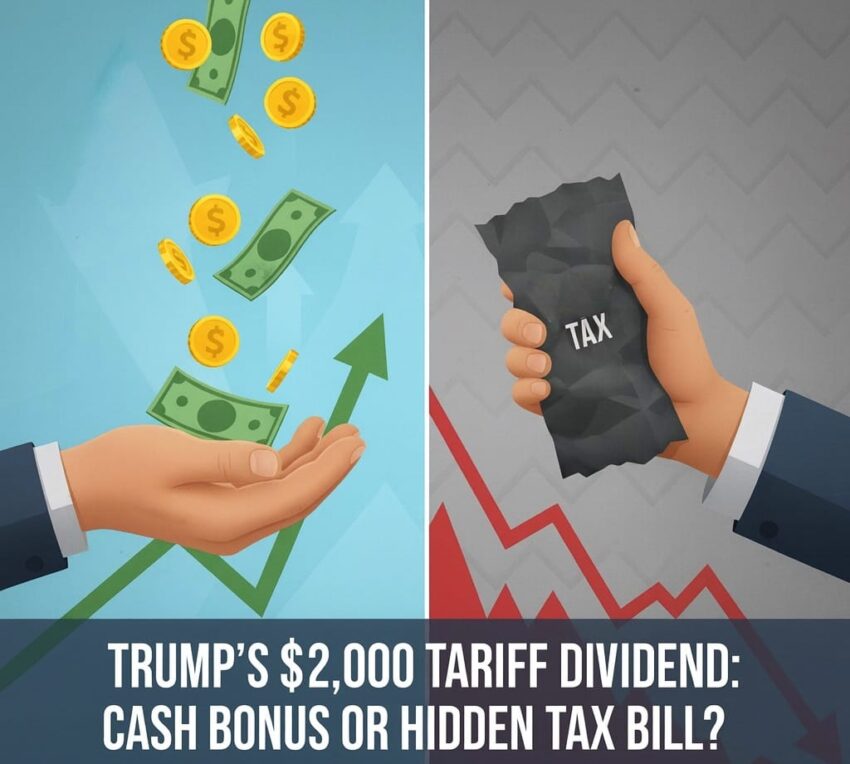
In late 2025, President Donald Trump introduced a headline-grabbing idea: a $2,000 “Tariff Dividend” paid directly to Americans. Many instantly compared it to a stimulus check. Others wondered if it was a new tax refund, a political slogan, or simply financial reshuffling.
The announcement followed the GOP’s weaker-than-expected midterm performance. Trump argued that because the U.S. is collecting “record tariff revenue,” Americans should receive a share of it.
However, economists, tax experts, and trade analysts quickly pointed out three critical facts:
- ➡️ Tariffs don’t work the way people think they do.
- ➡️ Consumers—not foreign nations—pay the cost.
- ➡️ Revenue collected is likely not enough for such a large payout.
This article breaks down everything investors and everyday Americans need to know about the Trump Tariff Dividend 2025.
What Exactly Is the Trump Tariff Dividend?
The proposed “tariff dividend” is not a standard tax credit, a stimulus check, or part of the IRS refund structure.
Instead, it is Trump’s proposal to use elevated import tax revenue to give a one-time, per-person payment to most Americans (excluding higher-income individuals).
How the Concept Works:
- U.S. imposes tariffs on imported goods.
- Importers pay the tariff at the border.
- Businesses raise prices to recover the tariff cost.
- Consumers pay higher retail prices.
- Government collects elevated revenue.
- Government sends that money back to people.
In Simple Terms: Consumers pay extra all year long, then receive a partial refund of the money they already paid.
Who Really Pays U.S. Tariffs? (Hint: It’s Not China)
One of the biggest public misconceptions is that foreign exporters pay U.S. tariffs. Trade studies consistently show the opposite.
✔ Importers pay the tariff to U.S. Customs. ✔ Companies then increase product prices to offset these costs. ✔ Consumers face higher prices on both imported and domestic competing goods.
This Leads to:
- Higher grocery bills and more expensive clothing.
- Increased prices for electronics, vehicles, and home appliances.
- Inflated costs for construction and manufacturing materials.
Bottom Line: The tariff operates like a consumer tax that is hidden inside retail prices. This is why many economists call the dividend a “tax shuffle” rather than true financial relief.
Tariff Costs: Did Families Already Pay the $2,000?
According to multiple cost-impact studies conducted in 2025, the average U.S. household paid approximately $1,800 extra this year due to tariff-driven inflation.
- Low- and middle-income families experienced the highest percentage increase in costs.
- Essential goods, including food and clothing, saw the sharpest price jumps.
So, even if the full $2,000 dividend were issued, families would primarily be getting back what they already lost to tariff inflation.
Can a $2,000 Tariff Check Actually Happen? The Math and Legal Reality
The dividend faces two major obstacles: not enough revenue and significant legal resistance.
The Math: Why Revenue Falls Short
While U.S. tariff revenue is high, the cost of the proposed payout is vastly higher.
| Metric | Revenue/Cost |
| FY 2025 Tariff Revenue | ∼$195 billion |
| Cost of a $2,000 Dividend (Estimate) | ∼$300 Billion to $600 Billion |
| Maximum Payout (If all revenue is redistributed) | ∼$1,234 per household |
Conclusion: The math does not support the promise. The revenue collected is far below what a full $2,000 per-person payout requires.
The Legal Hurdles to a Direct Payment
Even if the money were available, there are major legal roadblocks.
- Requires Congressional Approval: By law, tariff revenue goes to the Treasury. It cannot be redirected to households without Congress passing specific legislation.
- Supreme Court Review: The Court is currently reviewing the President’s tariff authority. If the tariffs are restricted or struck down, the revenue stream disappears, making the dividend impossible.
- Treasury Doubts Feasibility: Officials have signaled that a direct, lump-sum check may not be feasible. The payment may instead end up as a small tax adjustment or a minor tax cut on paper.
Legal experts believe the proposal is unlikely to result in a real, physical check for every American.
Economic Impact: Industries Hurt by Tariffs
Tariffs act as a tax on inputs, causing widespread negative effects on core American industries.
Manufacturing Sector
U.S. manufacturers face higher input costs, making machinery and components more expensive. Many pass these costs to consumers or cut jobs to survive.
- Since April 2025, approximately 42,000 factory jobs have been lost.
- Major companies like John Deere paid hundreds of millions in tariff-related costs alone.
Retail Industry
Retail prices have risen sharply due to the high cost of imported inventory. This has led to consumers reducing spending.
- Many retail workers are facing reduced hours or layoffs.
- Tariffs hit retailers hard because a large percentage of store inventory is imported.
Agricultural Sector
American farmers are squeezed from both directions: higher costs and lower sales.
- U.S. farm exports to China fell by about 53%.
- Farmers face higher equipment and fertilizer costs while global competitors replace U.S. suppliers.
Investor View & Final Verdict
Investors view the Tariff Dividend as political messaging, not firm economic policy. The market remains focused on underlying fundamentals.
| Pros (On Paper) | Cons (Real Impact) |
| Middle-class Americans get extra cash. | Consumers already paid more due to tariffs. |
| Lower-income families get temporary relief. | Not enough revenue for $2,000 checks. |
| High revenue gives the government flexibility. | Legal approval is highly unlikely. |
| Could increase inflation further. |
Final Verdict: The Trump Tariff Dividend looks like a bonus, but it behaves exactly like a refund of a hidden consumer tax.
FAQ: Quick Answers on Tariffs and the Dividend
1. What is Trump’s $2,000 tariff dividend? A proposed one-time payment using tariff revenue.
2. Who pays U.S. tariffs in 2025? Consumers pay indirectly through higher retail prices on goods.
3. Is the tariff dividend guaranteed? No, it requires Congressional approval and enough revenue, which is currently lacking.
4. Can tariff revenue cover $2,000 per person? No. The revenue is far below what the payout requires.
5. Will Americans benefit overall? Most families pay more due to tariffs and tariff-driven inflation than they would receive in the dividend.
6. Is the tariff dividend a new tax refund? No. It is not part of the standard IRS refund system.
7. Could tariffs increase inflation? Yes. Higher import costs often raise prices across the entire economy.
Secure Your Finances: Expert Guidance on Tariff Impacts
Tariff rules and trade policies affect business import costs, individual tax planning, and investment decisions.
At SR FinTax Advisors, we help you navigate trade policy uncertainty:
✔ Understand how tariffs affect your personal and business finances. ✔ Optimize your tax filings and reduce exposure to tariff-driven costs. ✔ Plan ahead for potential policy changes and volatile years.
Book your consultation today and get expert guidance before tariff changes impact your wallet.